
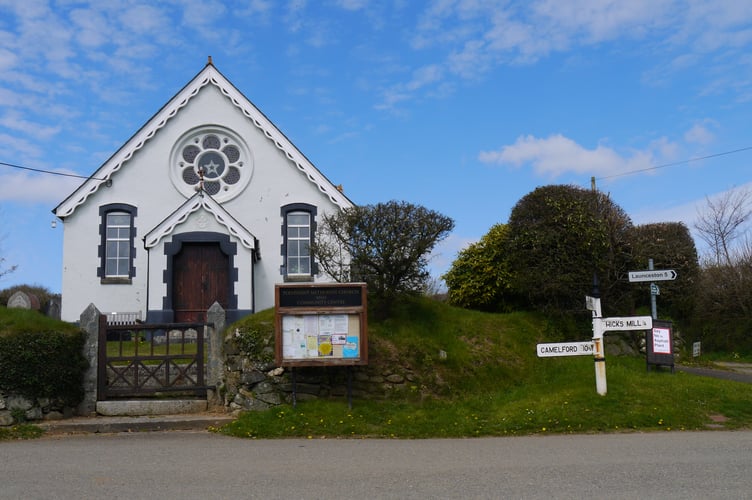
Pollefans: Poll – pool, lefans – toad
What3words - ///upwards.jumbo.island
Kynth usi semlant a ‘lies olifans’ – po neppyth ow tochya papynjays, martesen – dhe hanow sowsnek an dreveglos ma, hwithrans re dhiskwedhas bos an styr derowel ‘poll lefans’. Skrifys veu avel ‘Polefant’ nans yw mil vledhen, yn gwiryonedh. Ynter Perranarworthal ha S. Dey yma treveglos aral henwys Polkwilkyn, kynth yw kellys hy hanow koth lemmyn.
Yma Pollefans pymp mildir dhe’n howlsedhes a Lannstevan ogas dhe gemper Dowrow Inney ha Pennpons. Yn termyn eus passys, yth esa nebes mengleudhyow y’n ranndir may feu kevys men arbennik ynna, ‘men gwyrdh’ po ‘elven’ y hanow yn Kernow, hag a veu devnydhys gans drehevoryon Penneglos Truru rag gravya afinansow fin.

Y’n dedhyow ma yth yw treveglos gosel. Yma Eglos Methodek ha gwerthji kemeneth henwys ‘Teyr Bugh y’n Glesin’. Nyns eus na diwotti na koffiji, mes yn ogas y hyllir vysytya an ‘Kwilkyn ha Kelorn’ yn Peder Wynn Soth. Keslamm yw an hanow, dell hevel!
Although the English name of this village looks like “many elephants” – or perhaps something to do with parrots – research has shown that the original meaning was “toad pool”. In fact, it was written as ‘Toadpool’ a thousand years ago. Between Perranarworthal and St Day there is another village called Frogpool, although its old name is lost now.
Polyphant is five miles west of Launceston near the confluence of the Rivers Inney and Penpont. In days gone by, there were a few quarries in the area where a special stone was found, known as ‘greenstone’ or ‘elvan’ in Cornwall, which was used by the builders of Truro Cathedral to carve fine decorations.
Nowadays it is a quiet village. There is a Methodist Church and a community shop called ‘Three Cows on’t Green’. There is neither pub nor café, but nearby you can visit the ‘Frog and Bucket’ in South Petherwin. The name is a coincidence, apparently!
Community organisation An Rosweyth exists to promote the use of the Cornish language. www.speakcornish.com
Comments
This article has no comments yet. Be the first to leave a comment.