
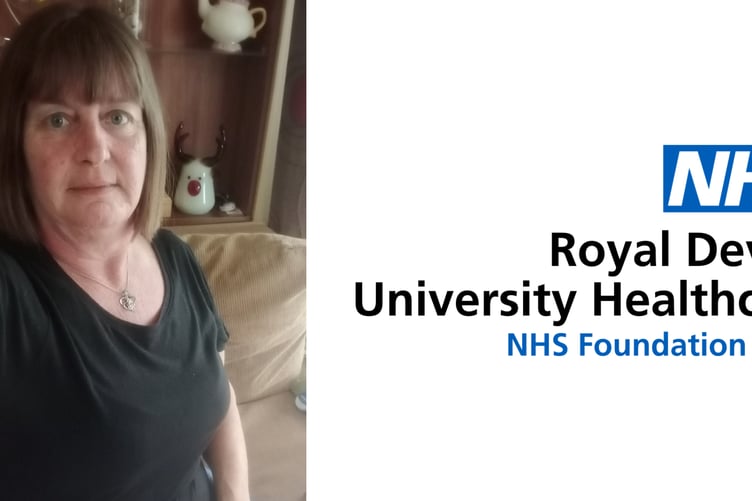
Amanda Dossett, 55, from Bude, had been suffering from increasing pain caused by osteoarthritis and, in 2023, scans revealed severe osteoarthritis in her left hip that required surgery. She was referred to Royal Devon University Healthcare NHS Foundation Trust for a hip replacement operation.
Amanda underwent surgery in December 2023 and initially believed her recovery was progressing as expected.
"I could feel the replacement moving around and rattling slightly but it wasn’t something I was concerned about," she said.
"The recovery period was incredibly difficult. Overnight, I went from being completely independent to relying on other people for almost everything. My mum, my sons and my friends were amazing, but it was hard having to depend on them so much,” she explained.
"I couldn't drive, I couldn't work, I couldn't even walk my dog. Having the operation so close to Christmas meant it completely overshadowed what should have been a happy time with my family. It felt like my whole life was put on hold."
Then, two days before Christmas, Amanda was asked by the trust to return to the hospital. It transpired that parts of the artificial hip implant had been mismatched, meaning the components were different sizes and incompatible with one another. The incident was categorised as a "never event", a serious patient safety incident that is considered entirely preventable.
Amanda was told she would need further surgery to correct the mistake, and underwent a second operation in February 2024 to replace the incorrectly sized component.
"I couldn't believe what I was hearing.,” Amanda continued. “You put your trust in medical professionals and assume that something as important as the size of an implant would be checked and double-checked.
"What upset me most was knowing that the second operation was completely unnecessary. I'd already gone through the pain, the recovery and the loss of my independence once. Being told I had to do it all again because of an avoidable mistake was incredibly frustrating and upsetting. I'd already been through weeks of recovery, only to find out I had to start all over again.




"It has really affected my trust in the hospital and the NHS. It's difficult not to lose confidence after something like this. It’s going to take a long time to rebuild my confidence and move forward after everything that happened."
While Amanda has avoided any serious long-term complications, she continues to experience occasional pain and cramping in her leg and says the additional surgical scarring has left her feeling self-conscious.
After the event, Amanda sought legal support from lawyers at Fletchers Solicitors.
The trust later admitted that the incorrect-sized component had been used during Amanda's original surgery and accepted that, had the correct implant been fitted, she would not have required the second operation.
It also acknowledged that Amanda would likely have recovered within six to 12 weeks of her initial procedure and been able to return to work and family life within that timeframe.
Commenting on the case, Michael Blakemore-Carson, clinical negligence specialist at Fletchers Solicitors, said: "This was an entirely avoidable incident that should never have happened. A 'never event' is one of the most serious categories of patient safety failure because it involves mistakes that are considered preventable when the correct checks and safeguards are followed.
"Amanda placed her trust in the healthcare professionals responsible for her treatment and, instead of being able to focus on recovering from a major operation, she was told that a fundamental error had been made and that she would need to undergo a second, unnecessary surgery.
"The consequences extended far beyond the operating theatre. Amanda lost months of her independence, was unable to work, faced financial pressures and had her recovery prolonged through no fault of her own. The impact was also felt by her family and friends, who had to provide extensive support throughout her extended recovery.”
Comments
We've recently changed our login process. If you have an account for commenting, you will need to re-register on the login window.
This article has no comments yet. Be the first to leave a comment.