
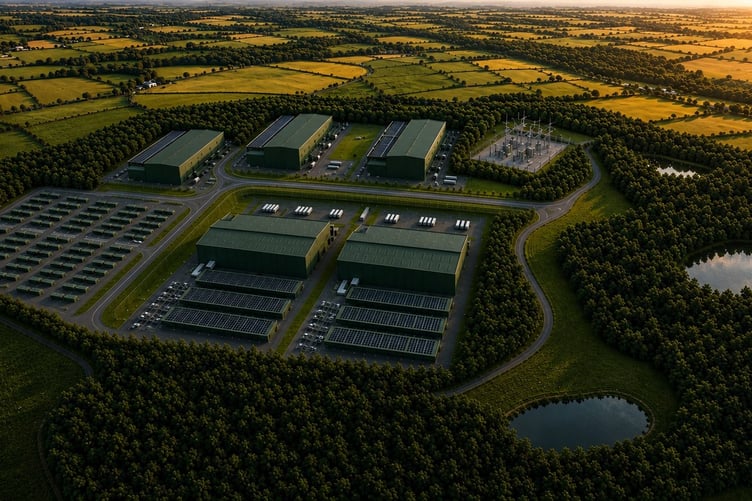
COMMUNITIES across the South West are up in arms following the news that an AI data centre which could span 850 acres could be coming to the region.
The £13-billion plans would see the construction of what the organisation is calling the ‘Devon data campus’, a space which would house GPUs, TPUs, and high-performance processors, with immense data storage and processing capabilities which are used to process the demands of AI workloads from across the world.
If completed, the site would be one of the largest data centres across Europe.
Explaining the reasoning behind plans, Xlinks said: “To meet AI demand, the UK needs more computing capacity. Today, the UK relies on AI data centres abroad, which creates data security risk and means the UK doesn’t benefit from the jobs and investment they bring. The NHS and police are just two of the organisations who are bringing data back onshore.”
The organisation has also suggested that the site could provide plenty of local benefits, stating that it expects to create between 650 to 1,200 permanent jobs and between 2,000 and, 3,500 during the construction period.
Despite this, for some the problem is simply environmental. Data centres have become infamous for their use of fresh water – something which is used in the cooling process, allowing the site’s hardware to keep running at all times.
Writing for the Environmental and Energy Study Institute, Miguel Yañez-Barnuevo, explains: “A medium-sized data centre can consume up to roughly 110-million gallons of water per year for cooling purposes, equivalent to the annual water usage of approximately 1,000 households. Larger data centers can each “drink” up to 5-million gallons per day, or about 1.8-billion annually, usage equivalent to a town of 10,000 to 50,000 people.”
However, beyond this, many have been left questioning ‘why here?’ in addition to asking why is such a substantial facility being built in the middle of the countryside?
Xlinks has described the site as having a ‘Goldilocks climate’, making it ideal for such a facility.


.jpeg?width=209&height=140&crop=209:145,smart&quality=75)

The spokesperson explained: “There is a ‘Goldilocks’ climate here: not too cold, not too hot, just right — reducing the need for heating and cooling and cutting energy and water use. The site is close to planned renewable energy generation, like offshore wind. The area also has strong fibre connectivity and available electricity grid capacity.”
As well as the industrialisation of natural spaces, residents have expressed their concern surrounding noise pollution.
Discussing the noise pollution caused by data centres for the Environmental and Energy Study Institute, Miguel Yañez-Barnuevo says: “When operating, data centres emit sounds from the humming of cooling systems and air chillers, the rumbling of diesel generators, and the whirring of fans. Together, these sounds can be heard for hundreds of feet around the facilities. Data centre neighbours have reported headaches, vertigo, nausea, sleep disturbances, ear pain, and hypertension.”
However, Xlinks has argued that there will be limited noise outside of the site, with a spokesperson stating: “There would be strict limits set as part of the planning process, which would be enforced across the campuses lifetime. We will also design in noise buffers, like landscaping and trees, and noise will be monitored to ensure it doesn’t breach limits.”
With no formal application submitted as of yet, Xlinks is undertaking a ‘consultation period’ in which it seeks to encourage discourse with residents from July 14 until August 11.
Despite this, the organisation has frustrated some locals, after it postponed ‘public information days’, meetings between residents and the organisation to discuss plans.
The company said: “The ‘Public Information Days’ previously advertised for July 14 to July 17, will no longer take place on those dates. We are moving them to later in the year, to allow more time to talk with local residents and to avoid the summer holiday period. New dates will be announced once confirmed, with as much notice as possible.”
With debate raging through the region, locals will be keen to make their thoughts known regarding this giant development.
Comments
We've recently changed our login process. If you have an account for commenting, you will need to re-register on the login window.
This article has no comments yet. Be the first to leave a comment.