
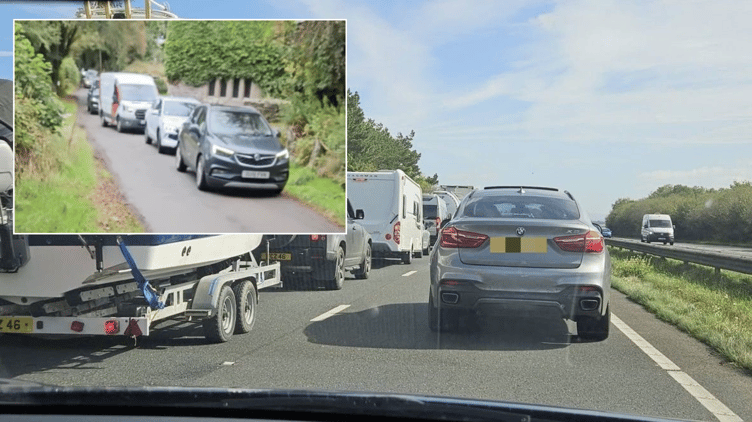
Cornwall councillors have criticised National Highways for “not listening” to advice before work started on road improvements on the A30.
The delays and lane closures have caused chaos and road rage as drivers are diverted on to narrow country lanes, through usually quiet villages and back on snarled-up slip roads on to the main road in and out of Cornwall.
Sat-navs are advising motorists caught up in the A30 works to depart the main road, leading to jams on rural roads ill-equipped for such heavy traffic. Drivers are finding that they are only diverted about half-a-mile before having to rejoin the queue on to the A30, which is leading to angry scenes.
The work on the A30 for the Kennards House to Five Lanes safety scheme, which started on September 5 and is due to last for another six months, is focused on six junctions: Plusha, Trevell, Two Bridges, Blackhill Quarry, Polyphant and the Highways maintenance depot. A spokesperson for National Highways said the aim is to improve road safety and divert traffic flows to more suitable junctions, while providing mitigation on local roads.
An interim barrier scheme carried out at the Plusha junction last year has already prevented right turns across the dual carriageway and the additional junction improvements and local authority road adjustments, as part of a £9.8-million scheme – including £8m of designated safety measures – are aimed at further driving down the number of incidents in the location, which has seen a number of fatalities.
Two councillors, who represent the areas affected, have spoken out this week on the mayhem that the work has caused.
Cllr Adrian Parsons, who represents Altarnun and Stoke Climsland, posted: “Another day of chaos on the A30 and the sat nav is advising people to cut through Trewint (and probably all the other rural villages off this section of the A30).
“All those who this falls under that couldn’t be bothered to listen or consult with the community over the last 12 months leading up to this work should hold their heads in shame. The poor management is now costing business and local people with hold-ups and delays. It’s unacceptable to think this is going to go on for six months.”
Adam Paynter, deputy leader of Cornwall Council and councillor for Launceston North and North Petherwin, told us that drivers’ sat-navs are urging them to turn off towards Trewint, leading to “loads of cars piling off there on to rural back roads. They go half a mile and literally come back and join the queue, so there’s a load of road rage there where people are trying to come out on the slip road and others already on the road don’t want to let them in.
“Others are trying to go up through the villages, through a rat-run of tiny roads, which causes even more of a problem – single tracks with high hedgerows where you have to reverse back. So as soon as you have a row of five or six cars, they get completely blocked up.


“Where the other side filters down, you’ve got the Tregadillett turning where cars are doing the same – they’re coming off and then end up going through the village, where you get equally upset people who are struggling to get out their front door because of the volume of traffic and it’s dangerous walking little Johnny to school”.
He said he and others, including Cllr Parsons, warned highways about the possibility of such problems before the work started. “National Highways really didn’t want to listen. We told them those little roads simply cannot take the volume of traffic.
“They’ve agreed with weekly meetings with Cornwall Council’s highways department, who are giving them advice on what they can do, so things are changing a bit.
“The whole issue was that we wanted a flyover at Plusha, which would have solved the problems where five people were killed. They’re saying it’s too expensive, but they’re now going to spend £9.8-million messing about with junctions, which really isn’t helping locals get where they need to go.
“Had they put a flyover in, I think locals would have been happy with other junctions being closed up and reduced. Anywhere where you’ve got cars crossing a busy dual carriageway is a recipe for disaster.”
Ali Packham is just one rural resident affected by the diverted traffic. She said: “Following the public meeting where the road improvements were unveiled, so many local people voiced their concerns and wrote in with predictions of what would happen on the lanes, mostly very narrow, and through our villages.
“As a local driver, dog walker and horse rider, the next six months are going to be pretty hellish. Surely this needs to be addressed?”
She had to abandon a horse ride on her usually very quiet route as “it was just too dangerous to continue”.
Other comments on a growing number of social media posts by concerned residents and motorists, include:
“Got caught in it too, today and last Sunday, what a complete nightmare!”
“Was stuck in that on Saturday and a two-hour journey took four hours! Whoever decided it was a good idea to force the merge from three lanes into one at EXACTLY the same point needs their head examined.”
“Waiting in my car to collect children from Tregadillett primary on Friday, it was scary to see some of the lorries using the village as a rat-run to try and avoid a short stretch of carriageway because the westbound traffic was backed up to the slip road. Many of them were thundering through way too fast for the road and not taking into account that this is a small village with traffic calming measures in place.”
“It’s getting ridiculously dangerous now – we witnessed a van with a trailer in the eastbound queue at Five Lanes decide it was okay to do a U-turn and drive the wrong way up the slip road. There are going to be some serious accidents.”
National Highways has responded to the concerns raised by Cllr Paynter and others.
A spokesperson said: “We’re sorry to hear about the frustration and disruption you and other road users have experienced as a result of the current traffic management arrangements.
“The scheme is being delivered to improve safety at six key junctions between Kennards House and Five Lanes following collision analysis which identified the need for improvements to visibility, junction layouts, road markings, signage and safety features. The long-term aim is to reduce both the frequency and severity of collisions on this section of the A30.
“We appreciate that it can be frustrating to see traffic management in place when no obvious work activity is visible. However, the traffic management remains necessary throughout the duration of the works to maintain a safe environment for road users and the workforce, protect equipment and partially completed works, and allow the scheme to progress safely.
“We recognise that some road users and local residents have experienced significant delays during the works, and we understand your concerns regarding the impact this can have on journey times, fuel costs and vehicle emissions. We appreciate how frustrating this is for those travelling through the area on a regular basis.
“We also recognise the concerns that have been raised regarding the suitability and effectiveness of the diversion routes and signing arrangements. We’ve received feedback from a number of customers about traffic using local routes and the impact this is having on nearby communities. The project team is actively reviewing this feedback and working with Cornwall Council and our traffic management partners to identify opportunities for improvements where appropriate.”
Comments
This article has no comments yet. Be the first to leave a comment.