

BEHIND a name sign on a fairly non-descript post World War II housing estate in Bodmin lies a story of one of its town’s most celebrated individuals.
The road is Finn VC Estate and the name of the person is James Finn, a man who lost his life in the war that was meant to be the only war of that size – World War I.
When Britain declared war on Germany in August 1914, James Finn was among the thousands of men who answered the call to arms. He enlisted almost immediately with his local regiment, the South Wales Borderers, beginning a remarkable military journey that would take him from the battlefields of France to Gallipoli, Egypt and Mesopotamia.
An administrative error at the time of his enlistment meant that his surname was recorded as “Fynn”. It was also mistakenly entered as “Flynn” on his campaign medal records, a discrepancy that has complicated the task of tracing his military service.
Although his original service record has not survived, other military documents and contemporary newspaper reports provide a fascinating account of his experiences.
Finn arrived in France on January 4, 1915, travelling aboard the troopship Kingstonian to Le Havre. After passing through the Infantry Base Depot, he joined the 1st Battalion, South Wales Borderers, on January 13.
Within months, he would distinguish himself through an extraordinary act of bravery.
During the Battle of Aubers on May 9, 1915, Finn risked his own life to retrieve a wounded company officer who had been left stranded in no-man's land. Despite Finn's efforts, the officer died of his injuries later that day.
Contemporary newspaper reports reveal that Finn was recommended for an honourable mention for his actions. His willingness to put himself in danger to help a fellow soldier would be echoed in another act of courage just eleven months later.
At some point during his service in France, Finn was also attached to the 170th Tunnelling Company of the Royal Engineers, alongside several other men from his regiment.


His own time on the Western Front was interrupted when he suffered wounds to his knee and chest. A casualty list dated June 28, 1915 recorded him as wounded while serving with the 1st Battalion.
He was returned to Britain for treatment at Seaforth Military Hospital, near Liverpool, and was discharged from hospital in September 1915.
During his recovery, Finn received a touching gesture of gratitude. The mother of Lieutenant Turner, the officer he had rescued from the battlefield, welcomed him into her home in North Wales as a way of thanking him for his bravery.
Finn's recovery did not bring an end to his wartime service. In the autumn of 1915, he was sent overseas again, this time as part of a reinforcement draft destined for the 4th (Service) Battalion of the South Wales Borderers.
On 14 November, he boarded the RMS Olympic at Liverpool, alongside 135 other ranks and three officers under the command of Captain Cahusac. The vessel sailed the following day, carrying the men towards the Mediterranean.
The Olympic, sister ship of the ill-fated Titanic, had been pressed into wartime service as a troopship.
While travelling towards Gallipoli, Finn found time to write to a friend in Abertillery. His letter, dated Sunday, November 28, 1915, provides a personal link to this chapter of his military life.
The reinforcements reached Gallipoli in early December, entering a campaign that was already approaching its final stages.
Following the Allied withdrawal from the peninsula, Finn's battalion was evacuated to Egypt.
An eyewitness account places him working in the officers' mess at Port Said in January 1916, offering a rare glimpse of his day-to-day duties away from the front line.
The South Wales Borderers were soon on the move once again. On March 4,1916, the 4th Battalion disembarked at Basra in Mesopotamia, in what is now Iraq.
During this period, Finn served as orderly to the battalion's commanding officer, Lieutenant Colonel C. E. Kitchin.
By then, he had already experienced the brutal fighting of the Western Front, survived serious wounds, recovered in Britain and travelled thousands of miles across several theatres of war.
Yet his most famous act of courage still lay ahead.
One of the most valuable surviving records of Finn's wartime experiences is a diary he kept during 1916.
The diary offers an important personal connection to a soldier whose official service papers have been lost. In 1966, it was handed over to the town of Bodmin, where it remains in the care of Bodmin Town Museum.
More than a century after the First World War, the surviving diary, military records and newspaper accounts continue to shed light on the remarkable experiences of James Finn and the courage he displayed in the face of war.
On April 9, 1916, Finn performed the action that he would be best celebrated and remembered for.
At Sanna-I-Yat in Iraq, during what was known at the time as the Mesopotamian campaign, Private Finn was brave in the face of danger as he sought to save his comrades in the trenches.
After a night attack from the enemy, Finn was one of a small party which dug in front of the advanced line, about 300 yards from the enemy’s trenches. Having seen several wounded men lying in front of the trench, Finn went out and bandaged them all while under heavy fire, doing so in several journeys.
When a stretcher was unavailable, Finn carried a badly wounded man on his back and into safety, before going back out and doing the same again.
However, he was never able to return to his home town to be celebrated for his achievement, for he would die in the field of battle in the following year, on March 30, 1917.
Indeed, he would never return home at all, with his body buried in the field of battle at the Basra Memorial, although there is no known grave among the many who died in the battle for freedom.
Instead, his father was presented to his father by King George V in a public investiture at Hyde Park.
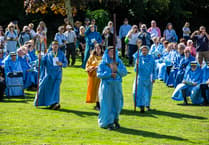
The name of James Finn was inscribed on the headstone of his father’s grave in Bodmin and in 2016, a commemorative paving stone was unveiled at Mount Folly, where each remembrance, wreaths are laid in honour of both Finn and those who fell alongside him.
And as for the housing estate? It was built in the location where Finn and his family had lived when it was known as Downing Street.
Comments
We've recently changed our login process. If you have an account for commenting, you will need to re-register on the login window.
This article has no comments yet. Be the first to leave a comment.