
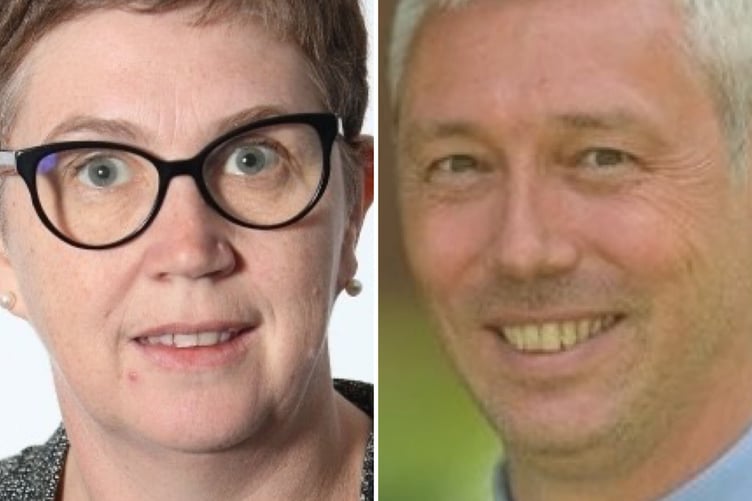
CORNWALL Council’s leader was quizzed by a member of the public at a cabinet meeting this week as to whether Cornish council taxpayers were effectively paying for two chief executives.
The unitary authority’s CEO and head of paid service Kate Kennally, who has been in the role for ten years, took a sudden and unexplained leave of absence earlier this month. The council then appointed an interim deputy chief executive, Andy Keeling, to oversee the council.
Ms Kennally receives a base salary of £201,661. Mr Keeling was paid around £137,000 to £140,000 per year as the chief operating officer and head of paid service at Leicester City Council, followed by a salary band of £145,000 to £150,000 per year as the chief executive of the Falkland Islands Government.
During Wednesday’s cabinet meeting at Lys Kernow in Truro, Mr J Hewlett, of Newquay, asked Cllr Leigh Frost: “Will the leader assure me personally, that my tax monies will only be used to employ one chief executive and head of paid service at any one time?”
The Liberal Democrat leader replied: “The council employs one chief executive and head of paid service. During the chief executive’s absence we’ve appointed an interim deputy chief executive to provide additional leadership capacity, to deputise as required.”
Mr Hewlett responded: “So in other words, we will end up paying for two chief executives. Does the leader have any objection if I and hopefully others draw a line in the sand and decline his inevitable offer to pay increased council tax charges next April due to his luxury beliefs that – and I don’t want to misgender anybody – we cannot keep a bitch and bark ourselves?”
Cllr Frost replied: “Well, I think that’s a bit inappropriate. The reality is, you can decline your council tax. That is your right, but there are responsibilities and consequences that come with that.
“What I would say is declining your council tax would hurt local people more; people that need adult social care services, people that need the children support, people that desperately need housing. So if you refuse to pay that, you are hurting those people more than you are hurting anyone else.”
The cabinet meeting later heard that at the end of the first quarter of this financial year, the council’s projected overspend stood at £17-million, but during the second quarter the council has introduced control measures that reduced that figure to £10.8-million, with more measures to come.
Mr Keeling told council staff last week: “We urgently need to bring our spending under control, not least because of the significant budget gap we have for next year. We have no head-room to end this year in deficit, so we need to act now.”

He said, as a result, the council is introducing some immediate spending controls in relation to pay and recruitment, conferences and seminars, spend on advertising and out of Cornwall travel. Mr Keeling has also told staff that the council is working with service directors (head of departments) to develop savings across every service.
“To help us do this, spending control panels will be set up in every directorate,” he wrote. “In addition, a pay cost control panel will be set up corporately so that we have more grip on changes to grades, acting up arrangements and overtime, as well as recruitment.”
During the meeting, Cllr Frost provided an update on the recent increase of pupils in Cornwall accessing free school meals, following the implementation of the council’s new automatic award process.
He said: “So far 17,485 children have been awarded free school meals, with 14,000 of those identified through the new automatic award process. This equates to an estimated £6.9-million a year in savings for their families.
“If proof were needed that this initiative would deliver on its promise to provide more meals for children who may otherwise have gone hungry at school, there you have it.
“Because pupil premium funding is linked to free school meal registration, identifying these additional children is expected to bring an extra £11.9-million into schools each year. Over the full six-year free school meals period, that equates to around £71.3-million in additional pupil premium funding for schools.
“That is a huge amount of money that our schools may otherwise have missed out on.”
The meeting also saw acknowledgement of the council’s recent ‘Good’ CQC inspection of adult social care services with its associated action plan.
Comments
This article has no comments yet. Be the first to leave a comment.