
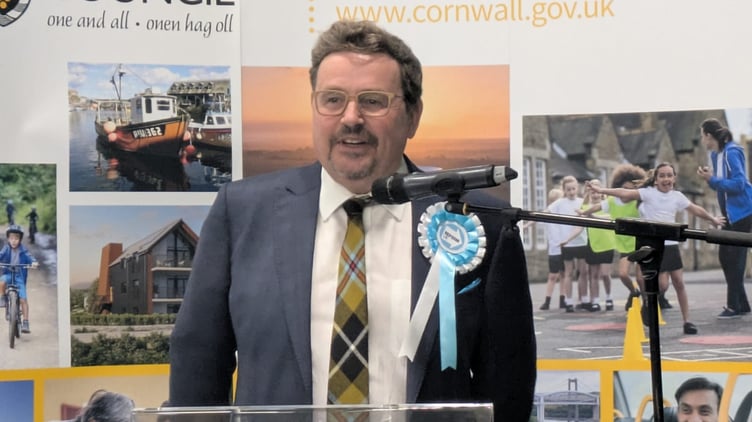
A REFORM UK councillor has demanded an emergency public meeting of Cornwall Council following the departures of three senior figures, calling for urgent answers about the authority’s leadership, finances and protection of public money.
Councillor Sean Smith, who represents St Cleer and Menheniot, wants the Liberal Democrat and Independent administration to bring councillors together at County Hall for a full briefing.
The call follows announcements that chief executive Kate Kennally, chief operating and finance officer Annabel Scholes, and service director Rachael Rothero are leaving the authority.
Cllr Smith stressed he was not suggesting the departures were linked, but said their timing raised important questions that needed answering.
“Three senior departures announced this month are cause for serious concern,” he said. “We are not claiming they are linked. We want clear answers about leadership, financial safeguards and the protection of services.
“The Liberal Democrat and Independent administration must bring all councillors together for a full public briefing. Residents deserve to hear the facts and the questions being asked on their behalf.”
Under the banner of “recall, explain and reassure”, Cllr Smith has set out three demands.
He wants an emergency public meeting to explain as much as legally possible about the departures, identify the officers now responsible for running the council and overseeing its finances, and set out the safeguards protecting public money.
He is also seeking an emergency motion requiring an up-to-date financial report covering the authority’s current position, its expected in-year shortfall, next year’s funding gap, borrowing, repayment costs and available reserves.
His third demand is for a plain-English account of the council’s income, spending and major contractual commitments, including their costs, who approved them and how value for money is assessed.



Cllr Smith said council staff had been warned in September of an anticipated £11 million in-year budget deficit and tighter spending controls. He also pointed to reported borrowing of £1.571 billion at March 31, 2026, which he said placed Cornwall seventh among English councils by total debt.
“The people of Cornwall deserve straight answers,” he said. “We need to see the current safeguards and know that qualified officers are in place to protect public money. Councillors and residents should be able to follow the money, understand the risks and judge the recovery plans.”
Cllr Smith has also questioned the council’s assessment of the risk of a Section 114 report, asking whether the authority still considers the likelihood of one being issued to be low.
A Section 114 report is a formal statutory warning issued by a council’s chief finance officer under the Local Government Finance Act 1988. It can be required when a council’s spending is likely to exceed the resources available to meet it, or in specified circumstances involving unlawful expenditure.
Cllr Smith wants the administration to explain the evidence behind its assessment that the risk remains low, alongside providing an up-to-date account of the council’s finances.
He also acknowledged that employment matters concerning senior officers had been considered in private by the Chief Officers Employment Committee, and referred to a committee member’s reported confirmation that they had signed a confidentiality agreement.
“I respect the need to protect personal employment information,” he said. “The council must still explain its decisions, financial commitments and leadership arrangements as fully as the law allows. Residents deserve openness. Councillors need the facts to do their jobs. The administration must provide both.”
Cornwall Council’s Liberal Democrat leader, Cllr Leigh Frost, sought to reassure residents following the third departure, describing the situation as a significant setback but insisting the authority had the leadership and experience needed to continue operating.
“I can’t pretend that it’s no problem at all,” he said. “However, we’ve had Andy Keeling come in as the interim deputy chief executive and he’s doing a really good job, so we’ve got that leadership in place, which is really important.
“The organisation doesn’t stand or fall on one person. It takes a bigger team to deliver and that team is there. They’re good at what they do and I have every faith in the work that they do. Whilst it is a pretty hefty bump in the road, it is only a bump.”
On the financial pressures facing the authority, Cllr Frost blamed years of underfunding, changes to the Government’s fairer funding review and rising costs.
He said the original proposals would have increased Cornwall’s funding settlement by £70 million, but changes subsequently left the council £50 million down. He argued Cornwall had ultimately emerged £3 million worse off than if the review had not taken place.
He also highlighted rising fuel costs and inflation, but insisted the council was not facing immediate financial collapse.
“There are 44 councils in the country that are already functionally bankrupt,” he said. “There are loads of councils getting exceptional financial support, which isn’t a good thing because it’s counter-intuitive – you have to pay it back. It’s not a place you want to be in and I don’t think we are in that place.”
However, Cllr Frost acknowledged the danger of further financial difficulties if local government remained inadequately funded. He said the forthcoming Quarter 2 report would show Cornwall was moving in the right direction.
Comments
We've recently changed our login process. If you have an account for commenting, you will need to re-register on the login window.
This article has no comments yet. Be the first to leave a comment.