
WHENEVER you are reading this column - whether online the Sunday before our print edition hits the presses, or in an actual physical newspaper on Wednesday - you could well be wrestling with one of the most baffling questions of the week.
That is, of course: which bin day is it tomorrow? Is it black bin week, aka general waste collection, or recycling week?
This is a dilemma I face every Sunday, and both are equally onerous. Black bin week involves emptying all household receptacles, as well as replacing the cat litter (hold nose) and raking out the rabbit hutch. Recycling week requires a brave soul (usually me) to tackle the cupboard under the kitchen sink, where all items are slung willy-nilly for triage at an unspecified but doubtless 11th-hour occasion.
Then there’s the growing pile of newspapers by my bedside; several weeks’ worth of supplements, held onto just in case I want to read/re-read my favourite columnists (I wonder if anyone does that with my work? Here’s hoping).
Let’s be honest, though: I may be protesting too much. Moi? Never! But yes.
As a family of three, the amount of rubbish we produce each fortnight surprises me in that it is so little. Sometimes, we hardly even fill a whole bag. I honestly think the reason for this is that we recycle assiduously.
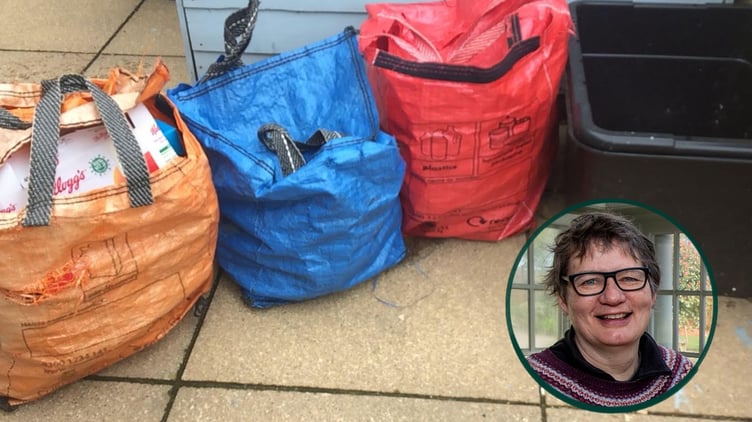
Paper, cardboard, plastic, metal … it has all been going in the multi-coloured bags for some time now. Apologies if this sounds a little bit sad, but I actually find sorting it all out quite therapeutic – just the kind of activity every Sunday morning needs.
We were saving green food waste for our compost bins; but when Cornwall Council announced it was introducing caddies that could take everything, including bread, meat, bones and pet food, I was cockahoop.
When it revealed plans to take Tetrapaks, and then soft plastics, I practically hyperventilated. No more dragging carrier bag collections to the supermarket, or arguing with the Other Half over whether this is even a thing! Just pop it in a bread bag and stick in the top of your plastics collection.
Even the pods from my coffee machine can be recycled, either at the dump – sorry, Household Waste Recycling Centre – or at the Co-op, which is more embarrassing for Daughter and therefore well worth the bother.




So I was really quite surprised, shocked even, to see the latest analysis of Cornwall’s rubbish. Cornwall Council estimates that half of what residents are putting in their black bins could have been recycled.
A study of 500 Cornish homes took place in July 2025 and November 2025, and the results were revealed to coincide with Recycle Week (September 14 to 20).
Alarmingly, around a quarter of household rubbish consisted of food, almost half of which was still in its packaging. This was despite weekly food waste collections being introduced in 2024, alongside the fortnightly alternating recycling and rubbish collections.
Plastics and metal, paper and card, textiles and glass – the very staples of recycling - made up 17 per cent of black bin contents. Batteries and vapes, which can cause explosions when crushed in the collection lorries, were also found among the rubbish.
The mind boggles, because the message isn’t exactly new. Just how hard is it to recycle? Sure, it comes with a little effort – and I can’t help suspecting that’s the main problem. The main offenders just aren’t willing to put themselves out. Perhaps we should be grateful they bother to bin their stuff at all, rather than just chucking it out of the window for someone else to deal with.
Don’t get me wrong, I’m not a saint. I feed our cat with pouches to avoid food going off in tins, and I admit washing all the pouches for the soft plastics is a little too much faff for me. We eat microwave meals on busy days, with all the packaging that comes with them. Mea culpa.
And of course, the mantra puts “reduce” and “reuse” before “recycle”. It behoves us all to do our best to try and eat food before it needs to be chucked, and to avoid buying too much single-use plastic. More often than not, it will save money as well as the planet – according to researchers from the Waste and Resources Action Programme (WRAP), the average UK family throws away £83 in wasted food every month.
It’s not all bad news, though. At county level, Cornwall’s recycling rate has increased by around 20 per cent. I’m sure anyone already on message would join me in urging the rest to think twice before putting things in the bin.
Remember, you can check if items can be recycled, find out what to put in your recycling bags and boxes, and find tips on how to reduce food waste on the Cornwall Council website.
Comments
This article has no comments yet. Be the first to leave a comment.