
WAYNE Rooney said what millions of football fans were thinking.
“C**p.”
One word. One brutally honest verdict. And perhaps the perfect summary of the 2026 World Cup’s most ridiculous moment – a bloated half-time show that turned the greatest match in football into an American-style entertainment circus.
The World Cup final should have been about the players. The drama. The history.
Instead, fans were treated to an 11-minute concert that stretched half-time beyond 27 minutes, delaying the return of the football everyone had actually tuned in to watch.
Rooney, working as a BBC pundit and who I’ve interviewed numerous times during his spell as Plymouth Argyle boss, was asked for his highlights of the show.
“I’ll be honest, mine was when it finished,” he said. “I like a lot of them artists, but I thought it was c**p. It just didn’t get me going and I wanted the football to come back on.”
For once, Rooney was speaking for the traditional football supporter. This was not the Super Bowl. This was the World Cup final. And that became the biggest problem with the entire tournament.
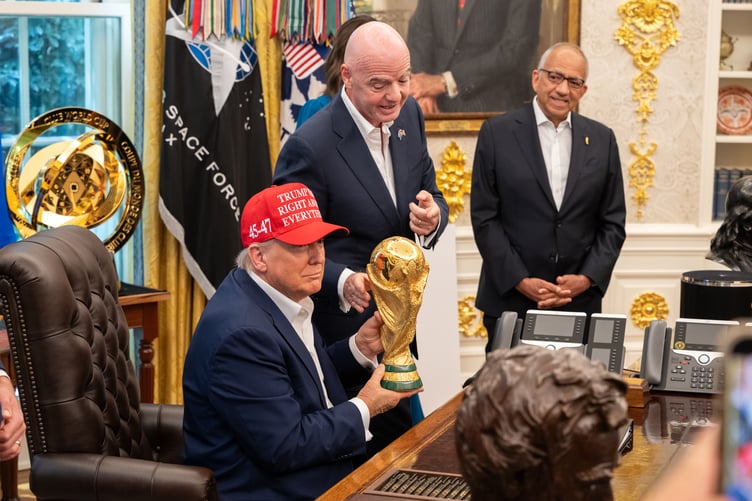
The 2026 World Cup increasingly felt less like football’s global celebration and more like America’s greatest show – with Donald Trump determined to make sure he had the starring role.
From start to finish, Trump’s influence was impossible to ignore. The tournament was supposed to be hosted by three nations: the United States, Mexico and Canada. Yet somehow it became the “American World Cup”.



Mexico and Canada’s contributions were repeatedly pushed into the background while America claimed the spotlight. The message was clear: this was less a celebration of North American football and more a chance for the US president to showcase himself on the world stage.
And then there was the extraordinary relationship between Trump and FIFA president Gianni Infantino.
The sight of the pair constantly praising each other certainly became uncomfortable viewing. FIFA has long claimed to stand above politics, but during this tournament the separation between football and power looked increasingly blurred.
Infantino appeared happy to embrace Trump’s influence, while Trump seemed delighted to present himself as the man behind the success of the tournament.
Sadly, it reached another level when Trump reportedly intervened after an American player was suspended, contacting FIFA officials and helping secure a change in the situation.
Whether it was pressure, persuasion or simply the power of the presidency, the message was uncomfortable: a phone call from the White House could apparently carry weight in football decisions.
And even after the final whistle, Trump could not let the moment belong entirely to the champions.
As Spain captain Rodri and his teammates lifted the trophy, Trump remained on stage, refusing to disappear into the background as Spain celebrated their greatest achievement.
It was the perfect image of the tournament.
The winners were Spain. But the spotlight still belonged elsewhere.
Away from the politics and pageantry, there were other frustrations.
The introduction of hydration breaks was another example of football being reshaped for the American market. Of course player welfare matters, but the constant stoppages damaged the flow of matches and interrupted the drama that makes football unique.
The World Cup is built on emotion, momentum and unpredictability.
Not scheduled pauses.
Then came Argentina.
A team blessed with incredible talent, most notably Lionel Messi, but whose behaviour became increasingly difficult to respect. Their constant complaints, confrontations and attempts to influence officials in the knockout stages left a sour taste.
By the final, I wanted them beaten. Not because they ended English hopes for another four years, but because their attitude became exhausting. A point illustrated when they turned their backs on Spain lifting the trophy.
The 2026 World Cup should have been remembered for the football. Instead, too many of the headlines were about concerts, politics, celebrity appearances and one man’s obsession with being at the centre of everything.
The greatest tournament in sport became a stage. The players provided the magic. But too often, everyone else tried to steal the show.
And perhaps Rooney’s “c**p” was the most honest review of all.
Comments
We've recently changed our login process. If you have an account for commenting, you will need to re-register on the login window.
This article has no comments yet. Be the first to leave a comment.