
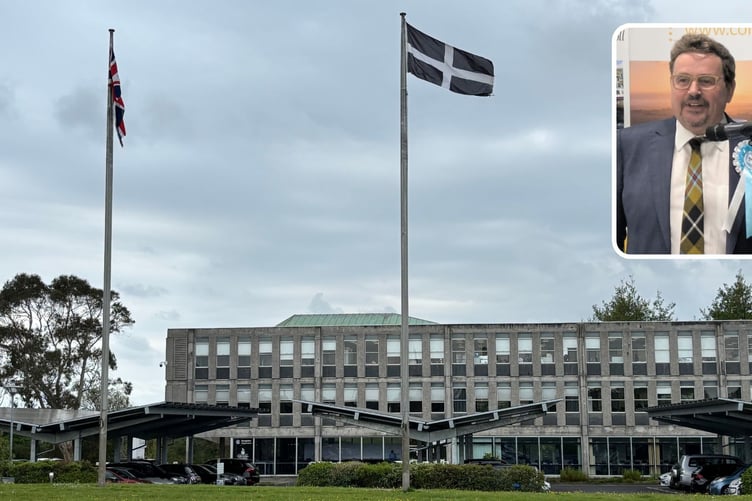
A Reform UK councillor on Cornwall Council has questioned whether there is public demand for the local authority’s strategy to promote use of the Cornish language over the next ten years.
The council’s community wellbeing committee considered the draft Cornish Language Strategy 2026-2036 at a recent meeting when Cllr Sean Smith asked if it had a public benefit.
The councillor for St Cleer and Menheniot questioned whether the proposals reflected the priorities of the wider population rather than “the relatively small group of committed language advocates”.
The Cornish Language Strategy 2026-2036 sets out the direction and priorities for the next phase of the revival of Kernewek, the Cornish language - and comes after the recognition in 2025 by the UK Government of Cornish under Part III of the European Charter for Regional and Minority Languages.




This enhanced status comes with a framework of further steps to ensure the longevity of the language. The vision is for the Cornish language “to be a thriving, forever language – widely spoken, seen and heard in everyday life in Cornwall”.
The first ten-year strategy for Cornish in 2005 focused on achieving greater visibility for the language such as through bilingual signage. The second ten-year strategy in 2015 aimed to create more opportunities to hear the language, for example through music and film. This new ten-year strategy will focus on creating opportunities to learn the language.
Its key goals include ensuring every child in Cornwall leaves primary school with knowledge and basic understanding of the language. Another goal is the establishment of the first bilingual Cornish language school.
Cllr Smith asked whether there was a public benefit to the strategy and whether continued investment represents an “appropriate use of council funds”. The language strategy receives annual funding of £170,000.
Cllr Sarah Preece, the Liberal Democrat cabinet member for localism, stressed the money comes from the government’s devolution settlement and not from Cornwall Council’s coffers.
“Can the officers provide evidence demonstrating that the outcomes achieved through the previous 2015 to 2025 strategy justifies continued public investment at a time when Cornwall faces significant pressure in housing, adult social care, children’s services and also economic inequality?” asked Cllr Smith.
The committee’s chairman Cllr Andrew Mitchell responded: “I think it’s a fair question, but our officers doing the Cornish strategy may not be the best people to ask that of. I think it’s fair to say, is this money being well spent? I think most people will say yes.”
Mark Trevethan, the council’s principal lead for culture, added: “It’s the UK government that is the signatory to the charter to protect the language and Cornwall Council’s stance has always been that the UK government should be meeting its obligations under that and contributing to the budget to protect the language. We’re always lobbying the Ministry of Housing, Communities & Local Government to support that.
“Partner organisations like Screen Cornwall very much see having the language as an asset to them. Companies like St Austell Brewery want to use the language and see it as a very useful thing to have for our distinctiveness, but it’s really hard to put numbers on that.”
Cllr Smith also asked if the scale of the proposed strategy is proportionate to public demand and whether the anticipated benefits are likely to be realised.
He said: “The strategy acknowledges there are approximately 500 people with advanced proficiency in Cornish and sets ambitious objectives including establishing a bilingual Cornish language school. Can the officers provide evidence there is sufficient public demand across Cornwall to justify that ambition?
“What evidence demonstrates demand from the parents for a bilingual school?” He also asked how many residents are currently learning Cornish.
Cllr Smith asked if the proposals reflected the priorities of the wider population rather than the “relatively small group of committed language advocates”.
Cllr Preece said: “It’s absolutely critical that Cornwall, its minority status and its language are protected and celebrated. Some aspects in terms of belonging, identity and inclusion are very hard metrics to identify.”
Mebyon Kernow councillor Loveday Jenkin welcomed the strategy. She said: “I see a lot of Cornish speaking in the community which I didn’t see 50 years ago. People who come in with no knowledge of the language don’t realise how much it has grown in the last 50 years. It behoves us as Cornwall Council to support that change.”
The meeting heard 30 schools are currently using the Go Cornish language programme, with a waiting list of others wanting to take part.
Comments
We've recently changed our login process. If you have an account for commenting, you will need to re-register on the login window.
This article has no comments yet. Be the first to leave a comment.