
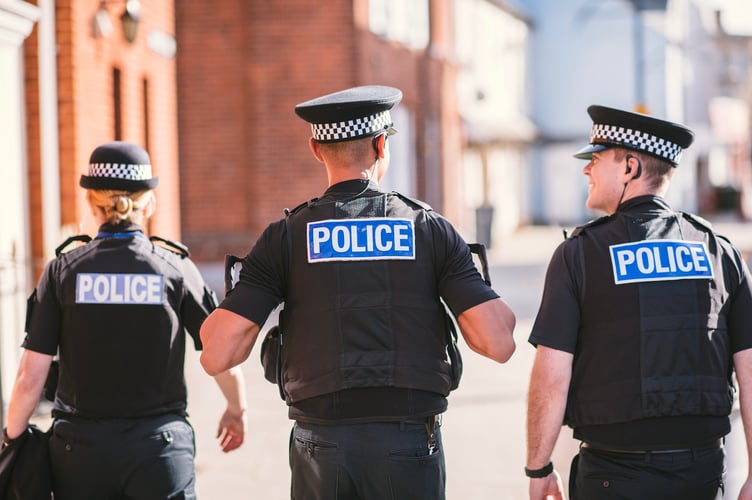
DEVON and Cornwall Police has spent almost £3-million replacing and buying police uniforms in just three years – with new figures raising questions over how much taxpayer money is being spent on clothing that may no longer be used by officers.
The force spent £2,904,647.26 on uniform procurement between 2023/24 and 2025/26, according to Freedom of Information figures obtained by Custom Embroidered Patches UK.
The spending breakdown reveals Devon and Cornwall Police's uniform bill passed the £1-million mark in a single year, with the force spending £1,101,956.35 during 2024/25.
That followed a bill of £861,255.56 in 2023/24, before costs reduced slightly to £941,435.35 in 2025/26.
The figures have placed the spotlight on how one of the largest police forces in England manages its uniform supplies, with questions being raised over whether more items could be cleaned, recycled or reused instead of replaced.
Devon and Cornwall Police’s current policy states that uniform accessories must be returned when officers no longer require them. However, items are only considered suitable for reissue if they are classed as unused or unworn.
This means previously worn garments, even if they remain in good condition, are generally removed from circulation and either securely destroyed, recycled or donated.
Campaigners behind the investigation claim the approach could result in forces repeatedly buying replacement clothing when some items may still have a usable lifespan.
The figures were gathered as part of an investigation into police uniform spending across the South West and compared Devon and Cornwall Police's costs with neighbouring forces.
Dorset Police spent £1,142,082.51 over the same three-year period, while Wiltshire Police recorded a total uniform spend of £1,219,178. Wiltshire’s figures also revealed that some unmarked, serviceable uniform items can be sold back to staff rather than disposed of.




Meanwhile, Avon and Somerset Police recorded the highest spending among the forces examined, with uniform costs totalling £4,545,326.71 between 2023/24 and 2025/26.
Thomas Green, founder and director of Custom Embroidered Patches UK, said police forces needed to look at ways of reducing waste while maintaining security.
“These numbers highlight the truly staggering financial burden that regional police forces currently face when equipping their officers for the front line,” he said. “When millions of pounds of public money are spent year upon year, the logistical challenge is clear, but these costs could be drastically reduced.
“Specialised police garments cannot simply be discarded due to severe security risks. It is absolutely vital constabularies continue to adopt robust recycling strategies, ensuring taxpayer money is protected.”
The Force covers more than 4,000 square miles across Devon, Cornwall and the Isles of Scilly, employs thousands of officers and staff, meaning uniform provision represents a significant operational cost.
Responding to the claims, Stuart Jose, Director of Procurement at Devon and Cornwall Police, said: “Devon & Cornwall Police is committed to ensuring officers and staff have access to safe, hygienic and fit-for-purpose uniform and equipment while making the best possible use of public funds.
“Expenditure on uniform and equipment is influenced by a range of operational and logistical factors, including officer and staff recruitment, training requirements, seasonal demand and long-term procurement planning. The period in question also includes the national Police Uplift Programme, which significantly increased officer numbers and required the purchase of additional uniform and equipment.
“Purchasing activity is planned to account for manufacturing lead times, supply chain considerations and wider market factors, including the impact of geopolitical events on the availability of raw materials. The Force also makes use of national procurement frameworks, helping to secure value for money through products that have already been tested and approved for UK policing. To ensure continuity of supply and operational readiness, orders are often placed in advance and in volumes that reflect anticipated future requirements rather than immediate demand alone.
“The Force seeks to maximise the value of uniform assets wherever possible. Uniform items may be considered for reissue when they are returned unused and can be verified as meeting required quality and safety standards. Items that have been worn are not normally reissued because their condition, hygiene, integrity and compliance with Force standards cannot be guaranteed. In addition, certain items of personal protective equipment have defined service lives and warranties that must be observed. Body armour, for example, carries a ten-year warranty, while handcuffs and batons are returned to manufacturers for refurbishment and testing before being reissued.
“Where uniform items cannot be reissued, Devon & Cornwall Police is committed to disposing of them responsibly and securely. The Force seeks to minimise waste wherever possible through recycling, sustainable disposal methods and charitable donations where appropriate and permissible. Disposal arrangements are managed in line with Force procedures and procurement requirements, ensuring police uniform is removed from circulation and cannot be reused inappropriately.
“The Force recognises the importance of delivering value for money for taxpayers. Decisions relating to uniform reissue are based not only on cost but also on officer safety, hygiene, security, operational effectiveness and public confidence. The costs associated with laundering, storing and managing second-hand uniform, together with the resources required to assess its suitability for reuse, must also be considered. Our approach aims to strike the right balance between financial responsibility, environmental considerations and the need to provide officers and staff with safe and reliable uniform and equipment.”
Comments
We've recently changed our login process. If you have an account for commenting, you will need to re-register on the login window.
This article has no comments yet. Be the first to leave a comment.